Service Robots: Definition, Types and Real-World Examples
A plain-English guide to service robots: what the term means, how professional and personal machines differ, and where you already meet them in hospitals, hotels, streets and homes.
Service robots are machines that perform useful tasks for people or for equipment, outside industrial manufacturing automation. They deliver meals in hotels, disinfect hospital rooms, assist surgeons, vacuum living rooms and inspect power lines. What sets them apart from a factory robot is the place they work: spaces shared with people, where nothing stays exactly the same from one minute to the next.
A service robot is a machine that does useful work for people, outside factory automation
The working definition comes from robotics standards and from the International Federation of Robotics (IFR): a service robot performs useful tasks for humans or equipment, excluding industrial automation applications. In practice, that means anything that is not welding, painting or assembling products on a production line.
The core difference is the environment. An industrial robot usually works in a fixed, controlled cell, repeating the same motion on parts that arrive in the same place. A service robot moves through hospital corridors, hotel dining rooms or sidewalks, where people, pets, doors and clutter keep changing.
Autonomy is the second test. An autonomous robot senses its surroundings and decides how to act on its own, for example choosing a path around a person. A remote-controlled machine only does what its operator tells it to do.
That is why a drone is not automatically a service robot. A drone flown entirely by a pilot is closer to a tool. A drone that follows a route, avoids obstacles and collects inspection data by itself fits the idea much better. Most real products sit somewhere in between, with a human supervising and stepping in when needed. You can follow how this field evolves in our everyday robotics news.
Professional and personal service robots: two markets with different buyers
The IFR splits service robots into two groups, and the split is about who buys them rather than what they look like.
- Professional service robots are used by businesses and institutions. Examples: inspection drones, surgery assistants, logistics robots, hospital disinfection robots, restaurant servers and field robots in agriculture.
- Personal service robots are bought by households. Examples: robot vacuums, robot lawn mowers, window-cleaning robots and entertainment or companion robots.
The IFR tracks both categories and publishes yearly statistics on them, and it is the reference source for market counts in this field. Any figure on the growth of the professional sector should be attributed to the IFR and checked against its latest World Robotics report, since numbers change every year.
One term comes up often in this area: a cobot, short for collaborative robot, is a robot arm designed to work next to people without a safety cage. It slows down or stops when it senses contact. Cobots began in factories, but the same idea of shared space now shapes many service robots. The jobs section below returns to this.
10 ways service robots are used in daily life, from delivery to disaster zones
These ten examples show where service robots already work. Some are products on sale, others are pilots or limited deployments, and the claims below are the companies' own descriptions.
- Logistics and delivery. Small wheeled robots from companies such as Starship carry parcels and food along sidewalks to cover the last mile, the final stretch to the customer's door. Amazon's Scout was a pilot of the same kind. For the warehouse side, see Amazon's logistics automation.
- Healthcare. Surgical systems assist surgeons, who stay in control of the instruments. Separately, UVD Robots machines disinfect hospital rooms with ultraviolet light.
- Hospitality. Pudu Robotics' BellaBot and KettyBot carry dishes and orders to tables in restaurants and hotels, so staff spend less time walking back and forth.
- Agriculture. Robots weed fields autonomously and pick fruit, tasks that are repetitive and depend on seasonal labor.
- Inspection and maintenance. Drones check bridges and power lines, which reduces the need to send people up towers or under structures.
- Domestic cleaning. Robot vacuums were the first service robots to reach millions of homes, and the category has since widened to mopping and window-cleaning robots.
- Customer service. Receptionist and information-guide robots, such as SoftBank Robotics' Pepper, greet visitors and answer basic questions in malls and shops. These customer service robots mostly handle simple, repeated requests.
- Security and surveillance. Autonomous robots patrol parking lots, warehouses and campuses, following set routes and flagging anomalies to human guards.
- Construction. Machines lay bricks automatically and map building sites, comparing progress with the plans.
- Search and rescue. Legged robots such as Spot from Boston Dynamics can enter places that are unsafe for people, including disaster zones, and send back images and data.
How service robots work: sensors, maps and learning
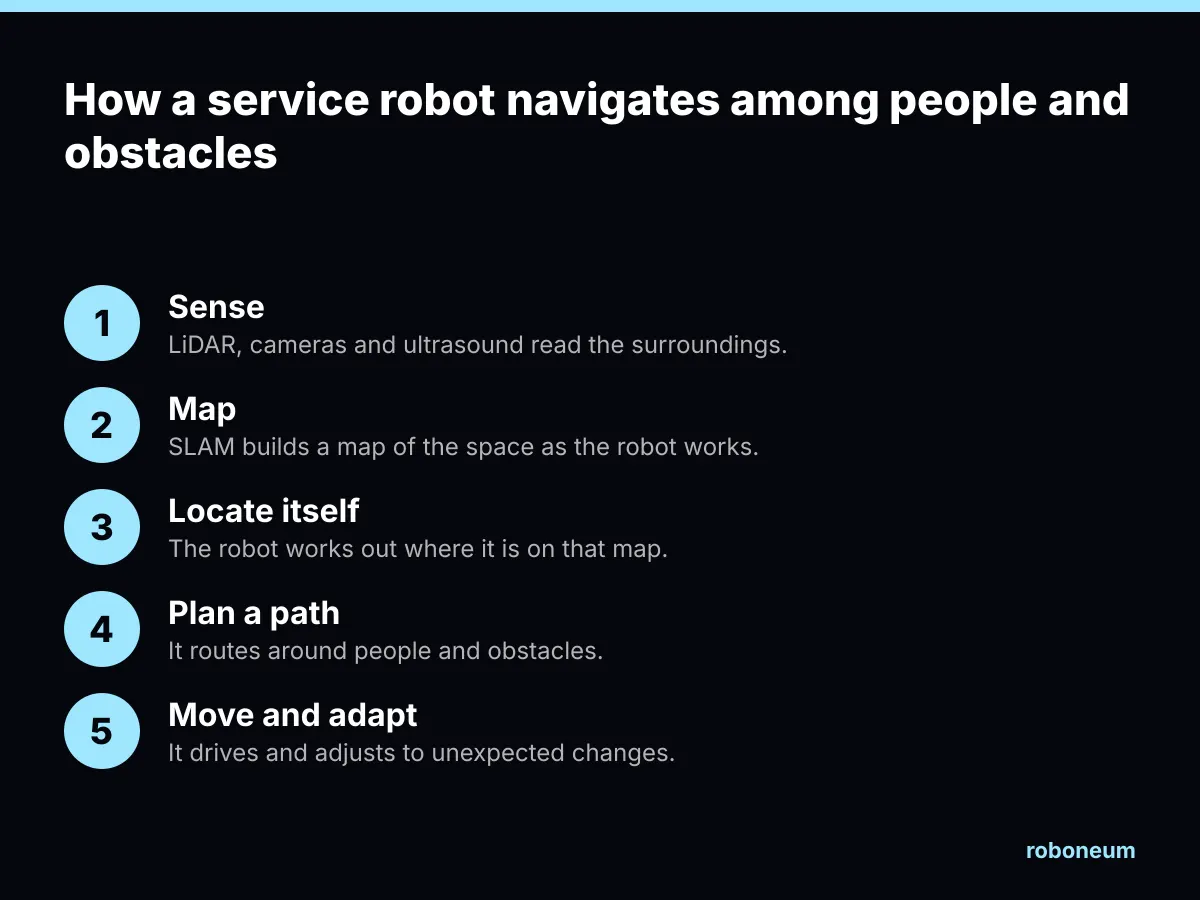
To move safely among people, a service robot has to answer three questions again and again: what is around me, where am I, and where can I go. The technology behind those answers comes in three layers.
Perception: how the robot sees
- LiDAR is a laser scanner that measures distance by timing how long light takes to bounce back. It produces a precise outline of walls, furniture and people.
- Cameras let the robot recognize objects, read signs or spot a person.
- Ultrasound sensors send out sound waves and listen for echoes. They are inexpensive and useful for detecting close obstacles.
Navigation: SLAM in plain words
SLAM stands for Simultaneous Localization and Mapping. The robot builds a map of a space while working out its own position on that map, much like a person exploring an unfamiliar building and sketching the floor plan as they walk. Once it has a map, it plans a path and re-plans if someone steps in front of it.
Physical AI: learning to adapt
Physical AI means artificial intelligence that controls a machine acting in the real world, not only software on a screen. In service robots, machine learning helps with tasks such as recognizing people, predicting how they will move and handling obstacles the programmers did not list in advance. It is one of the main areas of robotics research.
Major service robot companies and what a service robot costs
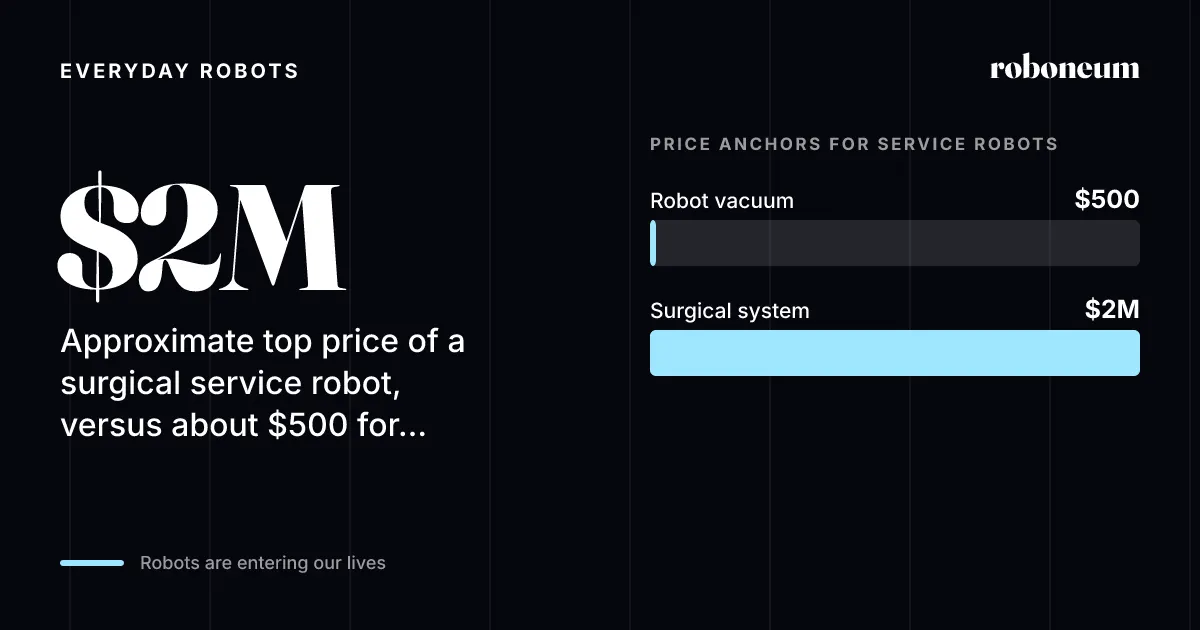
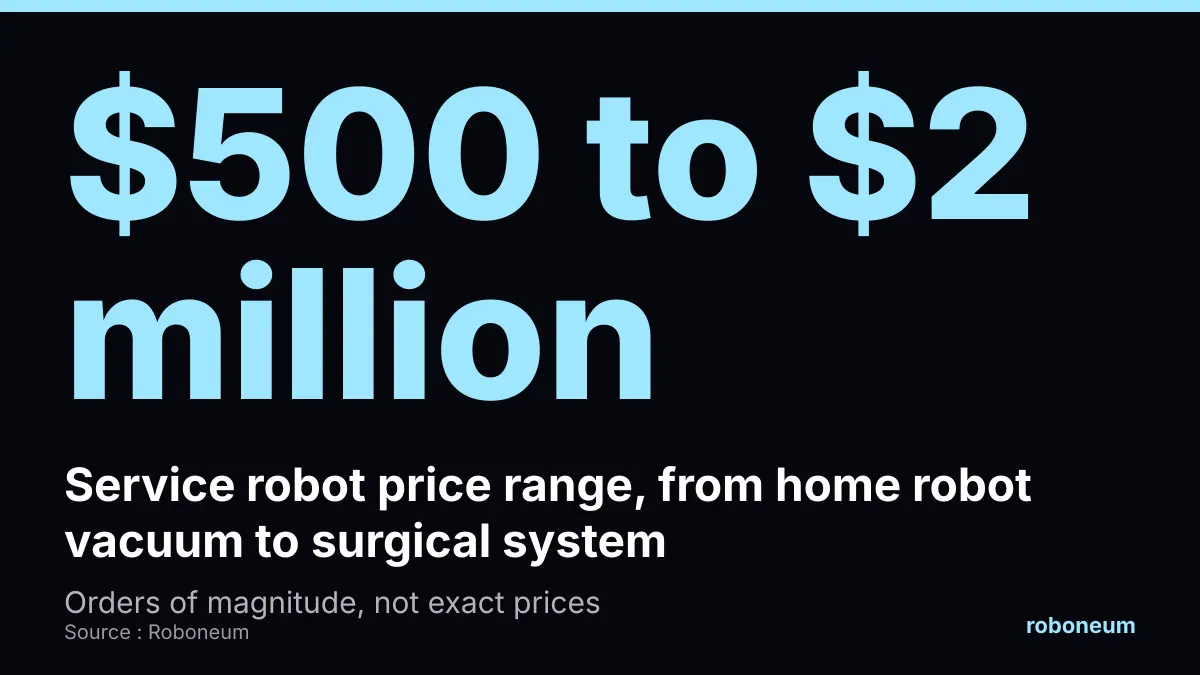
Service robots cost anywhere from a few hundred dollars to millions. As orders of magnitude, a domestic robot vacuum starts around $500, while a surgical system can reach about $2 million. These are anchors, not price lists.
The table below lists five well-known companies and the product or role each is known for. Prices are given only where an order of magnitude is established; otherwise the manufacturer sets them by quote or contract.
| Company | Known model or system | Primary function | Price range |
|---|---|---|---|
| Boston Dynamics | Spot | Legged robot for inspection and hazardous sites | Not publicly listed here |
| SoftBank Robotics | Pepper | Receptionist and information guide | Not publicly listed here |
| Intuitive Surgical | Surgical system (da Vinci) | Assisting surgeons in the operating room | Up to about $2 million (order of magnitude) |
| Unitree | Legged robots | Research, inspection and education | Varies by model |
| Pudu Robotics | BellaBot, KettyBot | Restaurant and hotel delivery | Varies by contract |
Why prices vary so much
- Sensors and compute: a robot with several LiDAR units and cameras costs more than one with a few ultrasound sensors.
- Payload and mechanics: carrying heavy loads or walking on legs needs stronger, costlier hardware.
- Level of autonomy: the more the robot decides alone, the more software and testing it needs.
- Safety certification: working close to people requires safety validation.
- Regulatory approval: medical devices go through strict approval, which is part of why surgical systems are so expensive.
- Service contracts: maintenance, software updates and training are often bundled into the cost.
People often ask how much a Serve Robotics robot costs. No price is given in the source material for this article. Delivery robot fleets are generally offered as a service to merchants and platforms rather than sold to individuals, so a single sticker price may not exist.
That model is called robots-as-a-service, where a customer pays for the work done rather than buying the machine. Our story on a robots-as-a-service funding round shows how investors are backing it in warehouses. For more on funding and company news, see the robotics business sector page.
Service robots and jobs: collaboration first, new roles alongside
In service settings, the common pattern is collaboration. This is the logic of cobotics: the robot takes repetitive or physical tasks, such as carrying trays or disinfecting a room, while staff keep the work that involves people, such as welcoming guests or caring for patients.
Service robots also create their own jobs. Someone has to install, clean, repair and update them, and someone has to watch them.
- Maintenance technicians repair sensors, wheels and batteries.
- Remote supervisors step in when a robot gets stuck or meets a situation it cannot handle.
- Fleet managers plan routes, schedule charging and track how a group of robots performs.
Service robots at a glance: recap table and how to keep following them
| Question | Short answer |
|---|---|
| Is it a service robot? | It does a useful task for people or equipment, is not factory automation, works near people and has some autonomy. |
| Professional or personal? | Professional robots are bought by businesses and institutions; personal robots are bought by households. |
| Where are they used? | Delivery, healthcare, hospitality, agriculture, inspection, cleaning, customer service, security, construction and rescue. |
| What do they cost? | From about $500 for a domestic vacuum to about $2 million for a surgical system (orders of magnitude). |
The newsroom will keep tracking new models, pilots and deployments. Subscribe to the Roboneum newsletter to follow how service robots evolve.
What are service robots?
Service robots are machines that perform useful tasks for humans or equipment, excluding industrial manufacturing automation. They include delivery robots, hospital disinfection robots, surgical assistants, robot vacuums and restaurant servers.
How much is a Serve Robotics robot?
No price is given in the source material for this article. Delivery robot fleets are often offered to businesses as a service rather than sold, so there may be no single public price.
What are cobot robots?
A cobot, short for collaborative robot, is a robot arm designed to work next to people without a safety cage. It slows down or stops when it senses contact.
What are 10 ways robots are used in our daily lives?
Delivery, healthcare, hospitality, agriculture, inspection and maintenance, domestic cleaning, customer service, security patrols, construction and search and rescue.
Does robot still exist?
Yes. Service robots are already working in hospitals, hotels, farms and homes, from robot vacuums to surgical systems and restaurant delivery robots.