AGCO Plans 2027 Pilot of Agility Robotics' Digit Humanoid in Kansas
AGCO and Agility Robotics plan a 2027 pilot of Digit humanoid robots at the Hesston, Kansas plant. What Digit will do, what is undisclosed, and how it compares.
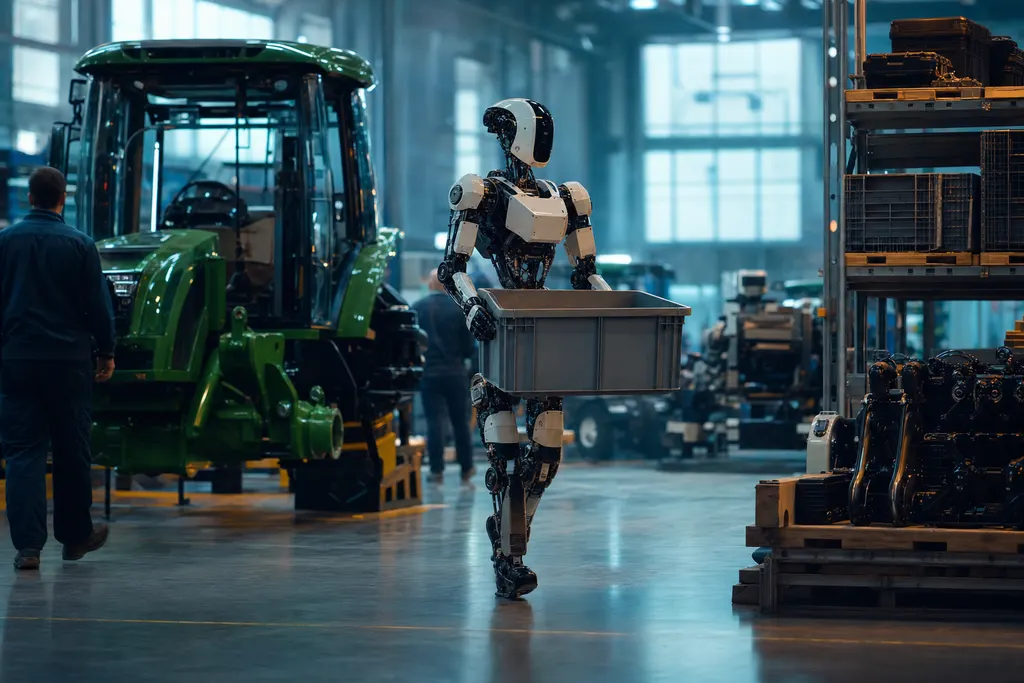
Farm-equipment maker AGCO and Agility Robotics announced on October 20, 2026 that they have signed a commercial agreement for a pilot of Digit humanoid robots at AGCO's plant in Hesston, Kansas. The pilot is planned, not under way: it is "expected to begin in 2027." It matters because it would put a walking robot into a tractor and farm-machinery factory, a setting where humanoids have so far been tested mostly in car and logistics sites.
This is a pilot agreement, not a fleet-scale deployment. The companies have not disclosed how many robots will be used, the contract value, how long the pilot will run or any plan to expand it, according to Let's Data Science and Forbes.
Digit is expected to start with sorting, stacking and tote placement
A humanoid robot is a machine with a human-like body, here a walking robot with two legs and two arms. Agility describes Digit as built for repetitive, physically demanding tasks in workplaces designed for people. In practice that mostly means moving totes (plastic storage bins) and parts.
According to the AGCO press release, Digit will "initially support key assembly and production operations including parts sorting and stacking, and intelligent placement of totes for storage." The release also says Digit uses AI to learn and adapt to changing workflows.
Digit will be paired with Agility Arc, the company's cloud platform for deploying and managing robot fleets. The companies say this allows automation "without requiring extensive infrastructure changes or costly facility upgrades." That is a company claim, and no independent test of it has been published.
Forbes reports that the pilot will likely use the newer Digit 5, which it describes as 5 ft 11 in tall and 284 lb, designed to work near people without a safety cage. The AGCO release does not say this. Agility's site notes that Digit 5 is still in development and its specifications may change.
The pilot has no published success measures
The companies have not named metrics, targets or a duration. They speak only in general terms of results that can be measured. AGCO's Thomas Enghof, Director of Manufacturing Technology, referred to "measurable business value." Agility's Chief Business Officer, Daniel Diez, referred to "measurable impact."
By pairing human ingenuity with robust robotic engineering and strict safety governance, we create resilient manufacturing systems that empower the workforce and deliver measurable business value.
Thomas Enghof, AGCO Director of Manufacturing Technology
Let's Data Science notes that the key evidence will be whether Digit can handle parts safely and reliably. The claims about ergonomics, efficiency and productivity are intended outcomes, not demonstrated results. Agility says Digit has more than 65,000 hours of real-world operation, a company figure that we could not independently verify.
For workers, the companies promise help, not replacement, but give no numbers
The release says automating repetitive and physically demanding tasks will "enhance ergonomic safety, improve operational efficiency and empower employees to focus on higher-value, skill-driven work." Forbes reports that AGCO sees humanoids as collaborators rather than substitutes. It also says the Hesston plant has made agricultural machinery for over 55 years and employs more than 1,100 people.
Neither company has given job-impact figures or any commitment on headcount. The framing is theirs and is not independently verified. Forbes calls the pilot a significant test of Digit's ability to work safely near human workers.
Other humanoid pilots have run longer and report numbers
AGCO says it joins Toyota, GXO and Schaeffler among companies deploying Agility's humanoids. GXO began with a proof-of-concept pilot in late 2023 at a SPANX facility in Flowery Branch, Georgia. It then signed a multi-year robots-as-a-service agreement (the customer pays a recurring fee instead of buying the robot), which Agility and GXO called the first formal commercial humanoid deployment. There, Digit moves totes from cobots (collaborative robots built to work beside people) or autonomous mobile robots onto conveyors. Amazon began testing Digit in 2023, initially for tote recycling.
In car plants, Figure's Figure 02 ran an 11-month deployment at BMW's Spartanburg site. Figure says it loaded more than 90,000 parts over about 1,250 runtime hours and contributed to production of 30,000 cars. Apptronik's Apollo is in pilots at Mercedes-Benz, with no operating figure published. Those numbers come from Figure and secondary aggregators, not from the AGCO release.
| Program | Robot | Status | Published figures |
|---|---|---|---|
| AGCO, Hesston, Kansas | Digit | Pilot planned for 2027 | None |
| GXO, Georgia | Digit | Pilot in 2023, then multi-year robots-as-a-service deal | About 100,000 totes moved at about 98% accuracy (secondary source) |
| BMW, Spartanburg | Figure 02 | 11-month deployment, Figure 03 now in the plant | 90,000+ parts loaded, about 1,250 hours (Figure) |
| Mercedes-Benz | Apollo | Pilots | None published |
The contrast is clear: the BMW and GXO programs have run for months or years and come with company-reported figures, while AGCO's has no numbers yet. For related coverage, see UBTECH and FAW-Volkswagen's humanoid logistics test and our guide to the main types of robots.
What to watch next
The first real data will come only after the pilot starts in 2027. Readers should look for the number of robots, the length of the trial, the safety record and whether AGCO says the tasks were done reliably. Until then, the agreement is a plan backed by company statements.
This article was written with AI by the Roboneum Newsroom, using only the sources it cites. Figures marked “Roboneum calculation” are our own arithmetic from those sources.