Types of Robots: 7 Main Categories With Names and Examples
A plain-English guide to the seven main types of robots, sorted by where they work: factory, warehouse, hospital, home, street and lab, with real examples of each.
What counts as a robot, and why sorting them by use helps
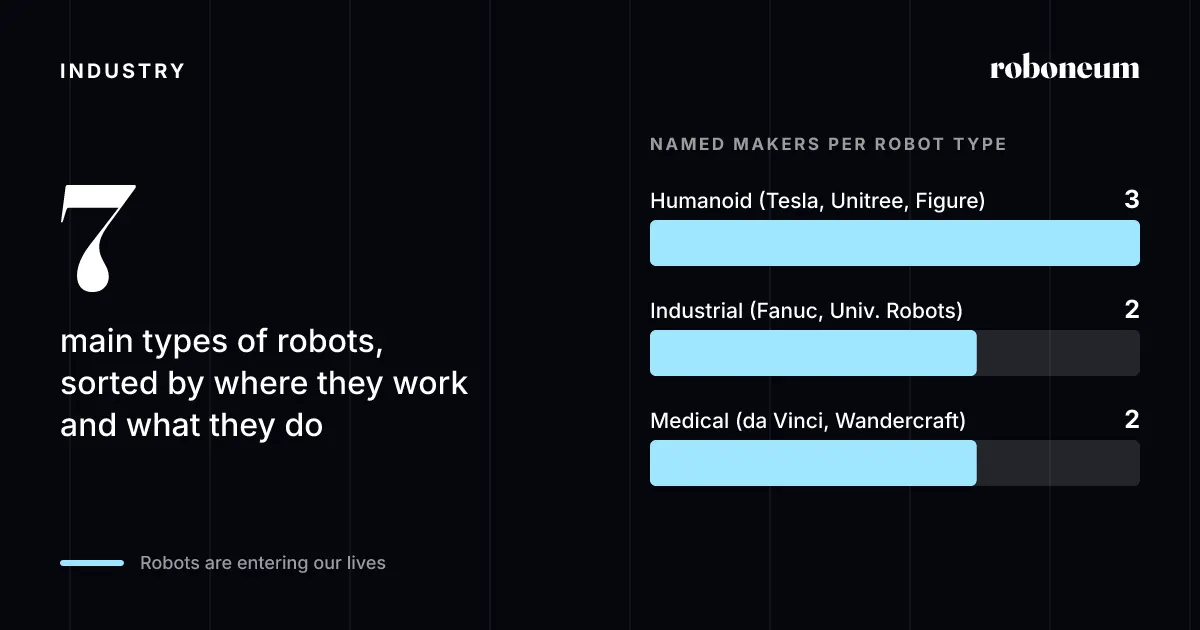
The main types of robots are industrial robots, collaborative robots (cobots), service robots, humanoid robots, autonomous mobile robots, domestic robots, and medical and research robots. Each one is defined by the job it does and the place it does it in. That is the most useful way to sort robots if you are new to the field.
In this guide, a robot is a physical machine that senses its surroundings, processes that information and acts on the world. Chatbots and other software bots are not robots, because they have no body and move nothing.
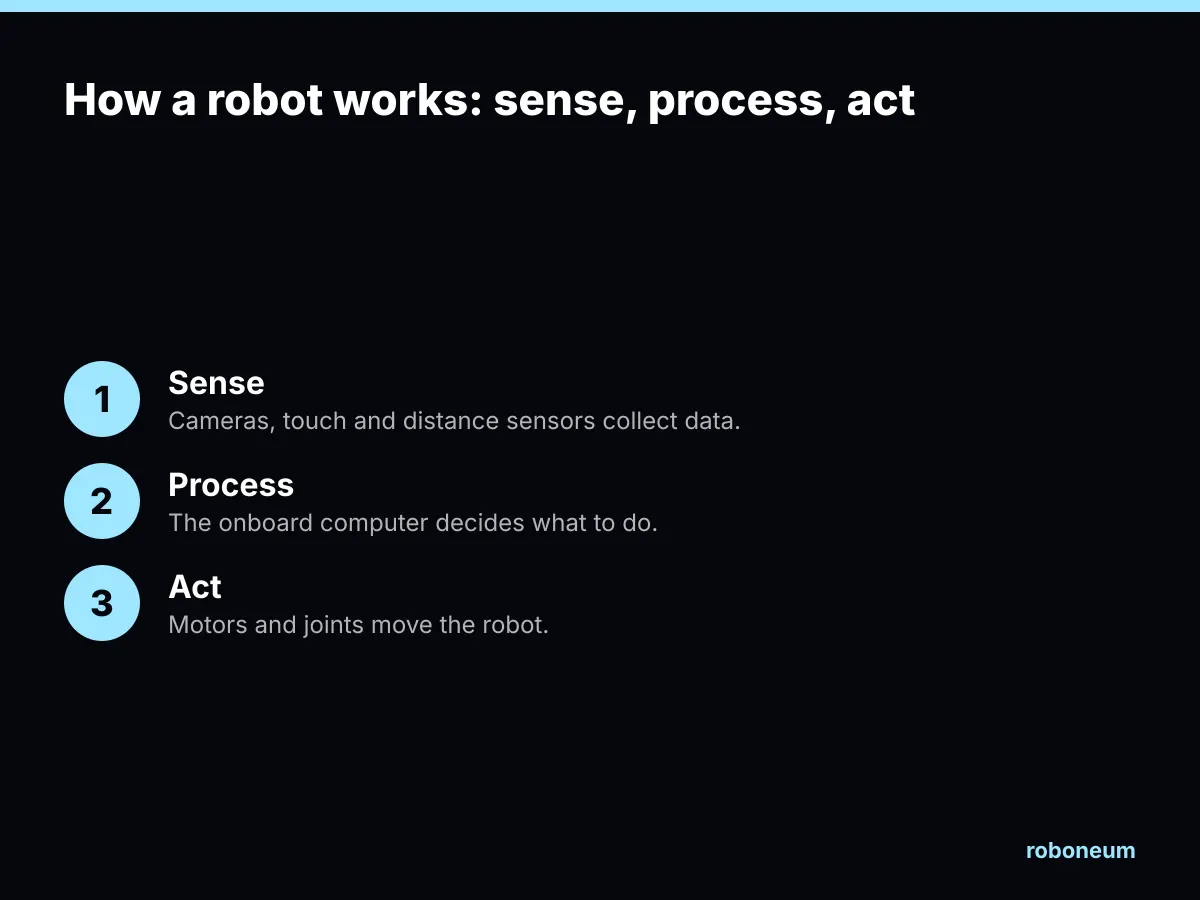
Every robot relies on three core components:
- Sensors: how the robot perceives, for example cameras, touch sensors and distance sensors.
- Processing: the onboard computer that decides what to do with that data.
- Actuators: the motors and joints that turn a decision into movement.
Many long lists of robot types sort machines by mechanical design, with names such as SCARA or Delta. Those labels matter to engineers. For everyone else, the question "where does this robot work, and what does it do?" explains far more, so that is how the seven types below are organized.
1. Industrial robots: the arms that built modern factories
Industrial robots are the oldest and most widespread type. Most are articulated arms: a robot arm with several rotating joints, a bit like a shoulder, elbow and wrist. They weld, paint, lift and place parts in automotive and electronics plants, repeating the same motion with high precision.
Fanuc is one of the best-known makers of these arms. Universal Robots is also a familiar name, though it is better known for the next category.
Traditionally, these machines were fast and powerful enough to be dangerous. They stood inside safety cages or behind fences, and people stayed out while they ran. Over time, sensors, safety scanners and more flexible software have let some of them work on more open factory floors, though the right level of protection still depends on the task.
2. Collaborative robots (cobots): machines that work next to people
A cobot, short for collaborative robot, is a robot arm designed to work next to people without a safety cage. It slows down or stops when it senses contact.
The difference from a classic industrial robot is a trade-off. Industrial arms favor speed and power. Cobots favor safe proximity, so they are often slower and carry lighter loads, but a worker can stand beside them and even teach them a task.
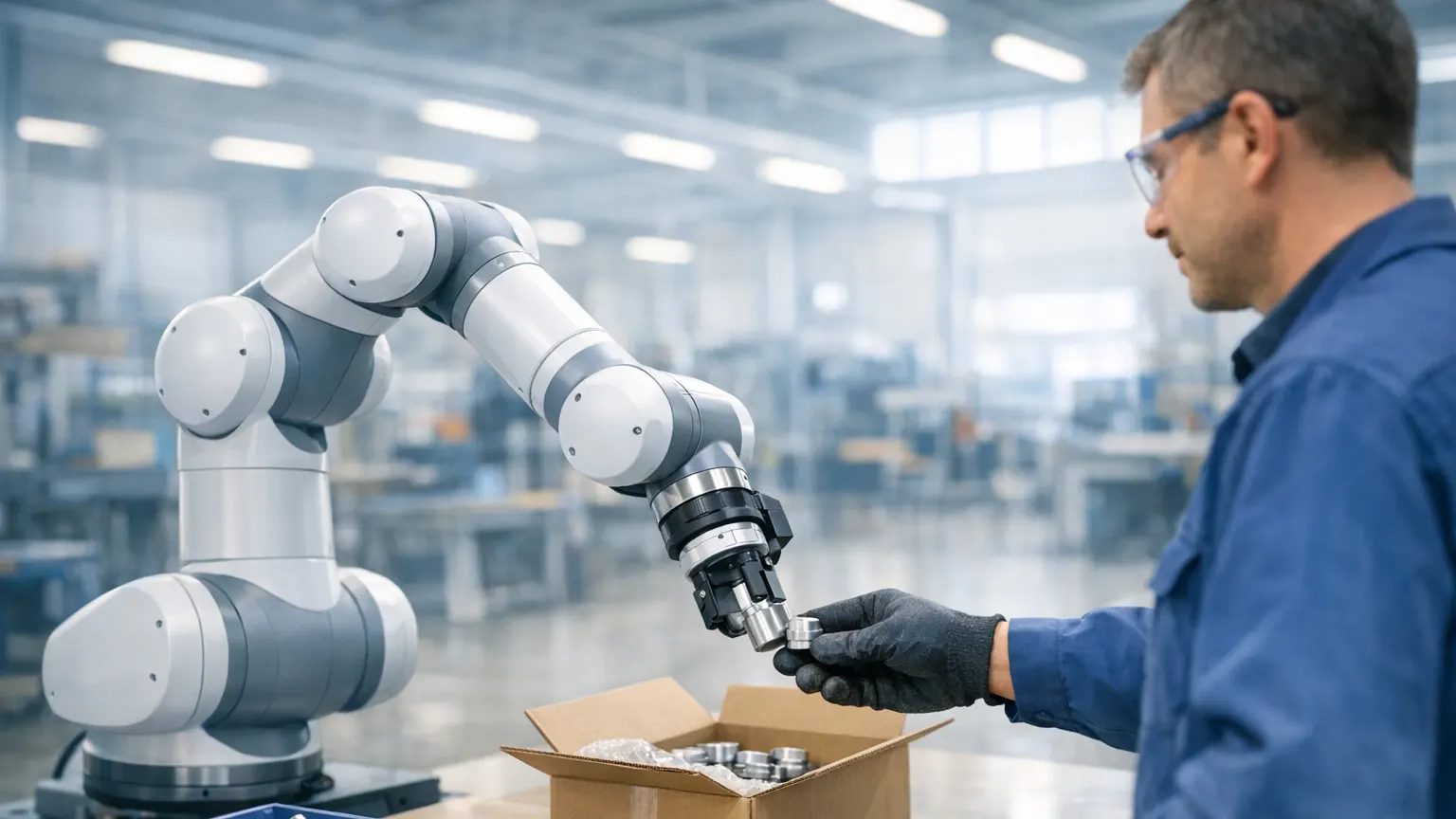
Two features make that proximity possible:
- Force feedback: the arm senses pushes and resistance, and halts when it meets something unexpected.
- Rounded edges: smooth, soft-cornered bodies reduce the risk of injury if contact happens.
Common cobot tasks are pick-and-place (moving items from one spot to another), packaging and light assembly. Universal Robots is a widely cited example of a cobot maker.
3. Service robots: helpers in hospitals, hotels and stores
Service robots do useful work for people outside the factory line. Professional ones operate in hospitals, hotels and retail stores, where they might carry supplies, deliver items to rooms or answer simple questions. Roboneum's guide to service robots: definition, types and real-world examples goes deeper into each use.
Their limits are real. Customer-service robots handle narrow tasks, hold only limited conversations and work best in controlled spaces such as a hotel corridor or a store aisle. A crowded or unpredictable room can stop them.
For the workforce, the visible change so far is that specific tasks shift to machines, such as carrying or delivering, while staff handle exceptions and personal contact. What that adds up to over time is not settled, and this guide makes no prediction.
4. Humanoid robots: general-purpose machines in a human shape
Humanoid robots have a head, torso, two arms and, usually, two legs. The reasoning behind the shape is practical: stairs, shelves, tools and workstations were all designed for human bodies, so a human-shaped machine could in theory use them without rebuilding the workplace.
Companies often named in this field include Tesla (Optimus), Unitree and Figure. Most humanoids today are prototypes or early pilots rather than mass-market products, and performance claims usually come from the companies themselves and have not been independently verified.
One example of a pilot is the test announced by UBTECH and FAW-Volkswagen, covered in Roboneum's report on the UBTECH and FAW-Volkswagen humanoid logistics test.
The hardest engineering problem is bipedal locomotion, walking on two legs. A two-legged robot is never fully stable: it must constantly sense its tilt and adjust its joints to avoid falling, especially on uneven floors or when carrying a load.
5. Autonomous mobile robots (AMRs): moving goods without a driver
An autonomous mobile robot, or AMR, is a wheeled robot that chooses its own route instead of following a fixed track or magnetic strip. It is the workhorse of modern logistics.
Warehouses are the main home of AMRs. Amazon Robotics is the best-known example, and Roboneum has covered the company's scale in Amazon's 1 million robots and what it means for workers, as well as a new site in Amazon's robotized warehouse in Beauvais, France.

Smaller robots also handle last-mile delivery, the final leg of a trip from a local hub to a customer, rolling along sidewalks and streets in some cities.
Navigation works in three plain steps:
- Sensors such as cameras and lidar (a laser distance scanner) build a map of the surroundings.
- Software plans a path from the starting point to the destination.
- The robot adjusts as it goes, stopping or steering around people, boxes and other obstacles.
6. Domestic robots: vacuums, mowers and window cleaners
Domestic robots are the type most people already own or have seen. The main consumer categories are robot vacuum cleaners, robot lawn mowers and window-cleaning robots. Each does one chore with little supervision.
Smart home robotics has moved from single-task devices toward more connected machines that can map a home, be controlled from a phone and work on a schedule. The core idea is still the same: one robot, one job.
Consumer-grade robots differ from industrial ones in what they are asked to do. They cost less, handle simpler tasks and face less strict demands for speed, precision and durability than a robot running through a factory shift.
7. Medical and research robots: precision, rehabilitation and extreme environments
This type covers machines where precision or safety matters most. The best-known surgical assistant is the da Vinci system. A surgeon sits at a console and controls the instruments, so the robot assists and does not operate on its own.
Exoskeletons are wearable robotic frames that support or move a person's legs, and some are used in rehabilitation. French company Wandercraft is one name in this area, and Roboneum covered its plans in Wandercraft opens a Paris factory.
Research robots also go where people cannot easily follow: space (planetary rovers), underwater (robotic submersibles) and disaster zones (machines sent into damaged or hazardous buildings).
What role does AI play in robotics?
AI gives a robot the ability to make sense of the world and decide what to do. This is often called physical AI: artificial intelligence that perceives and acts in the real world, rather than only producing text or images.
Two uses stand out. Computer vision lets a robot recognize objects, such as a box, a tool or a person. Pathfinding lets a mobile robot plan a route. Both are typically built with machine learning, where a system learns patterns from many examples instead of following hand-written rules.
Data is a large part of this. Roboneum reported how Mecka AI is raising money to train robots with human data in Mecka AI raises $60 million to train robots with human data.
AI software on its own is not a robot. Without sensors and actuators, there is nothing physical to sense or move.
Quick comparison: the 7 types of robots at a glance
| Type | Where it works | What it does | Example named in this guide |
|---|---|---|---|
| Industrial robots | Factories | Welding, painting, lifting and placing parts, often at high speed | Fanuc |
| Collaborative robots (cobots) | Factories and workshops, next to people | Pick-and-place, packaging, light assembly | Universal Robots |
| Service robots | Hospitals, hotels, stores | Carrying, delivering and answering simple questions | See the Roboneum service robots guide |
| Humanoid robots | Pilot sites in logistics and manufacturing | General-purpose tasks in spaces built for people | Tesla Optimus, Unitree, Figure |
| Autonomous mobile robots | Warehouses and city streets | Moving goods along self-chosen routes | Amazon Robotics |
| Domestic robots | Homes and gardens | Vacuuming, mowing, cleaning windows | Robot vacuums and mowers |
| Medical and research robots | Operating rooms, rehab clinics, space, underwater | Assisting surgeons, supporting movement, exploring | da Vinci system |
To identify any robot's type, ask four questions:
- Where does it work?
- Does it share space with people?
- Does it move around on its own?
- Is it built for one task or many?
To follow new releases across the robotics industry, subscribe to Roboneum's newsletter and browse the topic pages for industrial robots and humanoid robots.
What is the role of AI in robotics?
AI helps a robot interpret sensor data and decide what to do. Typical uses are computer vision, which recognizes objects, and pathfinding, which plans a route. The robot itself still needs sensors and actuators to act in the physical world.
What are the big 4 of robotics?
The phrase most often refers to the four large industrial robot makers: ABB, Fanuc, KUKA and Yaskawa. It is an informal label, not an official ranking.
What are the types of robot programming?
Common approaches include teaching an arm by moving it by hand or with a handheld controller, writing code for it, simulating tasks on a computer before running them on the robot, and training it through machine learning from examples.
What are three famous robots?
Three well-known examples are Unimate, an early industrial arm used in car manufacturing; the da Vinci surgical system; and the Roomba-style robot vacuum, which brought robots into many homes.
More robotics guides
Service Robots: Definition, Types and Real-World Examples
A plain-English guide to service robots: what the term means, how professional and personal machines differ, and where you already meet them in hospitals, hotels, streets and homes.