Tesla Starts Optimus Humanoid Production in Fremont, Warns of Slow Ramp
Tesla says Optimus production began at Fremont, but Musk expects a slow ramp and outside deliveries around late 2027. What is known, and what is not.
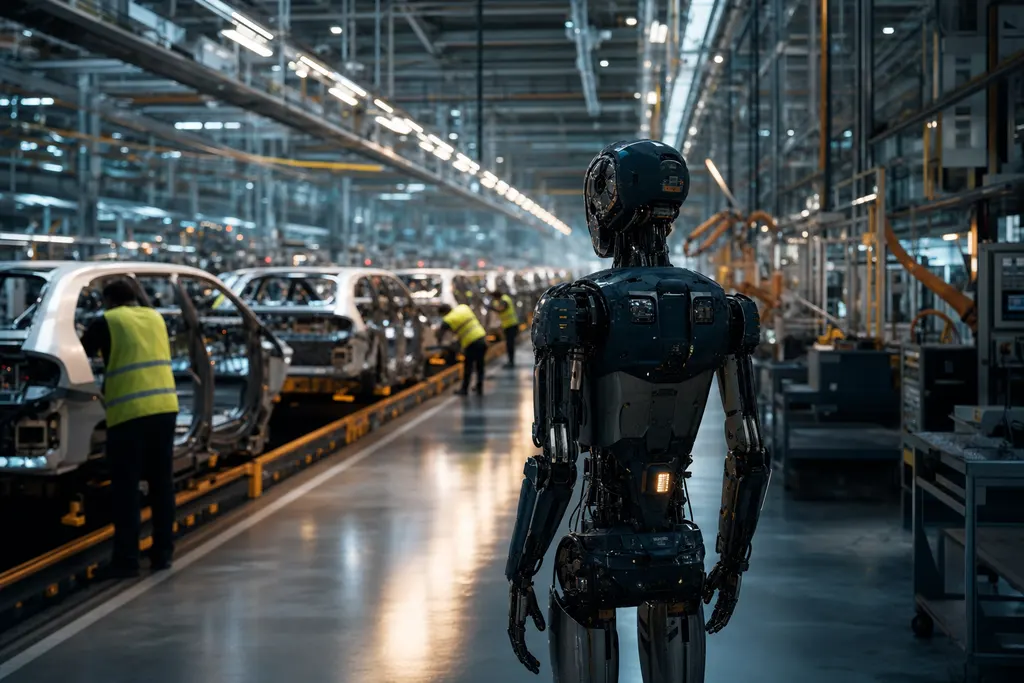
Tesla says it has started building its Optimus humanoid robot on high-volume lines at its Fremont, California, factory. Elon Musk told investors on October 21, 2026, that the ramp-up will be slow. For readers, the key point is that a production start is not the same as robots doing paid work for customers, and Tesla says that second step is still about a year away.
The news came in Tesla's Q3 2026 update and on the earnings call that followed. Most of the figures below are Tesla's own and have not been independently verified.
Tesla says the first production-quality Optimus bots are coming off the line
Tesla's update states: "Optimus production began in Fremont on our high-volume lines. The bots coming off this line are the first production-quality bots that we have manufactured." It also says Tesla has "proven that the current manufacturing process for Optimus is suitable for a commercial product," as reported by TeslaNorth. The company added that it will keep iterating on the hardware and the process.
The update leaves out a lot. Tesla gave no production rate, no unit count, no price and no date for outside sales. It did not say which version of the robot is being built. Its capacity table lists Fremont Optimus as "Early Ramp" and Texas as "Construction," with no capacity number for either, according to The AI Insider.
Musk asked investors to temper expectations
On the call, Musk described "early production" that would be "somewhat bumpy because it is such a radically new product." He spoke of a "shallow slope" and said "there's like 10,000 things that have to go right." He added: "I want to temper expectations," as reported by Yahoo Finance and TechCrunch.
He also made volume claims. Musk said Tesla has "the vast majority of a million-unit-per-line production line landed in Fremont." Reaching 20,000 units a week, about 1.04 million a year, will take "probably at least a year, maybe a little longer," according to eletric-vehicles.com.
Some outlets report this as 20,000 a week by the end of 2027. NeoTeo stresses that this is a forecast, and that an installed line is capacity, not actual output. Another aggregator reported a near-term target of more than 1,000 a week by the end of 2026, but we did not find that in a primary source.
The robots are not yet doing customer work
Musk said deliveries to companies outside Tesla should be expected "around the end of next year." They would start with dangerous, repetitive or round-the-clock industrial jobs. Home robots would come later. Early builds went toward collecting training data, per The AI Insider.
He was frank about the gaps. "There's still some things we need to tweak about the design... it can't, like, wear out after a month," he said. He also said "there's still quite a lot of work to do with regard to the AI and the robot for it to be truly useful for open-ended tasks." He expects both to be solved around the end of next year.
Tesla needs roughly 10,000 to 20,000 bots practicing tasks to generate training data, and is building what it calls an "Optimus Academy" for that. Musk said a video of Optimus doing tasks that are not pre-programmed could come in one to two months. Until it appears, claims about open-ended ability remain unproven.
Hands and durability were reported trouble spots
A September 25 report, as summarized by eletric-vehicles.com, cited "major manufacturing and durability challenges" with the robot's hands. It pointed to intricate assembly, supplier limits and breakdowns of automated assembly equipment at Fremont. It said output rose from a few dozen a week in Q2 to several hundred, without being dependable at scale. This is a secondary account, and Tesla has not confirmed those numbers.
A slow ramp suggests gradual change for Fremont workers
In January, Musk said Model S and Model X production would end so Fremont floor space could go to Optimus, with a stated goal of one million units a year there. Tesla said in Q2 that it had decommissioned the S and X assembly lines to build the first Optimus lines, per TeslaNorth.
We found no Tesla figures on headcount or job changes. A slow ramp suggests a gradual rather than sudden shift in Fremont work, but that is our inference, not a reported fact. For how another large operator handles this, see our look at Amazon's million robots and its workers.
Tesla cut its capital spending forecast to about $20 billion
CFO Vaibhav Taneja said Tesla is "revising our CapEx guidance to be approximately $20 billion for the current year as a result of managing our capital deployment efficiently." The earlier guidance was more than $25 billion. One Yahoo summary wrongly says capex was raised; Taneja's own words show it was cut.
Even at $20 billion, 2026 spending is more than twice 2025's $8.5 billion, according to a Yahoo Finance/TIKR piece. Tesla plans to pay mainly from operating cash flow. It has secured up to $30 billion of borrowing capacity and does not plan to draw on it in 2026.
| Item | Figure |
|---|---|
| Q3 capital spending | $4.732 billion (about 18% below Q2; analysts expected about $7.9 billion) |
| Operating cash flow | $6.263 billion |
| Free cash flow | $1.531 billion |
| Revenue | $28.05 billion, roughly flat |
| GAAP net income | $787 million, down 43% |
| Adjusted earnings per share | $0.48 vs. $0.45 expected |
| Operating expenses | $4.78 billion, up from $3.43 billion |
Higher operating expenses were driven by research, AI computing, chip development and pre-production costs for Optimus, Megapack 3 and the Semi, according to Investor's Business Daily. Tesla expects them to keep rising until those products are commercialized. The stock fell about 3%.
For comparison, other humanoid makers are further along in named pilots, such as AGCO's planned 2027 Digit trial in Kansas. Today, Optimus is a production line starting up, not a product in service.
This article was written with AI by the Roboneum Newsroom, using only the sources it cites. Figures marked “Roboneum calculation” are our own arithmetic from those sources.