Amazon's 1 Million Robots: What the Milestone Means for Workers
Amazon's 1 millionth robot arrived in June 2025, yet the debate over speed, safety and the roughly 1.5 million people working beside the fleet is still going.
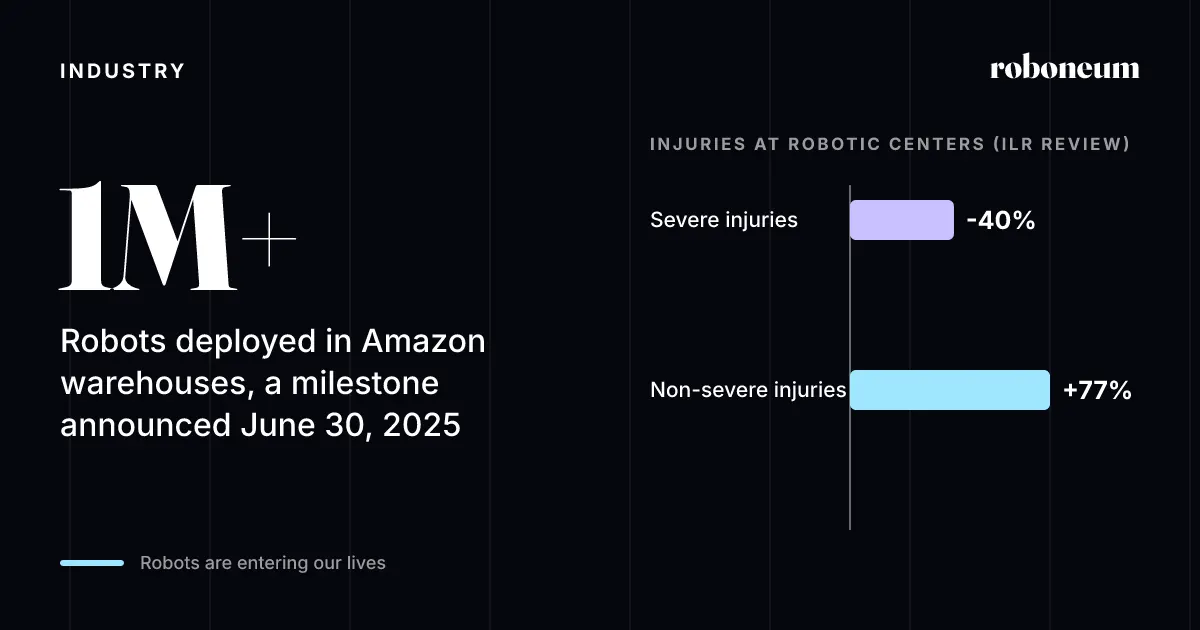
Amazon has deployed more than 1 million robots in its warehouses, but the milestone is not new. The company announced it on June 30, 2025, when its 1 millionth robot was delivered to a fulfillment center in Japan. Coverage on October 17, 2026 by BGNES, NewsBytes and Futurism revisits the figure with a focus on the people who work alongside the fleet.
Amazon's 1 million robot milestone dates to June 2025, not October 2026
In its original announcement, Amazon said the robot joins a global network of more than 300 facilities. The company calls itself the world's largest manufacturer and operator of mobile robotics, meaning robots that move around a building rather than stay bolted in place.
No newer robot count has been published in the material reviewed. The October 2026 stories reuse the 2025 figure and add commentary on workers. Amazon began building this capability after it bought Kiva Systems in 2012, according to TechCrunch.
DeepFleet: the AI model Amazon says speeds up the fleet by 10%
With the milestone, Amazon launched DeepFleet, a generative AI foundation model that coordinates robot movement across its fulfillment network. A foundation model is a large AI model trained on broad data that can be reused for many tasks.
According to Amazon, DeepFleet improves fleet travel time by 10%, so packages reach customers faster and at lower cost. That is a company figure and has not been independently verified. Amazon says the model was built on its own inventory-movement data, using AWS tools including SageMaker.
Robots already touch most of the business. TechCrunch, citing the Wall Street Journal, reported that 75% of Amazon's global deliveries are assisted in some way by a robot.
What the fleet does: nine robot types next to about 1.5 million people
PCMag, citing the Wall Street Journal, said the fleet included nine types of robots. IBTimes SG lists Sequoia, Hercules, Titan, Vulcan, Sparrow, Robin, Cardinal and Proteus, and also mentions Project Eluna, an agentic AI model (one that can take steps toward a goal on its own).
Headcount figures differ depending on the source and on what is counted. TechCrunch, citing the Wall Street Journal, also said Amazon's warehouses may soon have as many robots as people.
| Source | Headcount figure | Scope |
|---|---|---|
| PCMag, citing the Wall Street Journal | 1.56 million | Employees at the time of the 2025 milestone |
| GeekWire | About 1.5 million | Global employees, about 1.2 million of them in warehouses; based on company numbers and public estimates |
| Amazon annual filing, via IBTimes UK | About 1.58 million | Full-time and part-time employees worldwide, end of 2025, including staff outside warehouses |
Amazon's case: upskilling, new technical roles and continued hiring
Scott Dresser, vice president of Amazon Robotics, said: "These robots work alongside our employees, handling heavy lifting and repetitive tasks while creating new opportunities for our front-line operators to develop technical skills."
- Amazon says it has upskilled more than 700,000 employees since 2019.
- Amazon says its next-generation fulfillment center in Shreveport, Louisiana, launched in late 2024, needs 30% more employees in reliability, maintenance and engineering roles.
- CNBC reported that CEO Andy Jassy said Amazon will keep hiring in AI, robotics and other areas, even as AI eliminates jobs in some areas.
Critics and researchers: pace of work and injury data are disputed
Brad Greenwood, a business professor at George Mason University, told Ars Technica that the fleet's growth "really changes that dynamic for two reasons: one is that it is physically proximate, and two, the robot has the ability to dictate the pace of work." The quote comes via Futurism and BGNES.
Joan Moriarty of the Strategic Organizing Center, a trade union coalition, told Ars that Amazon "doesn't want to talk about the tens of thousands of Amazon workers who are injured every year due to Amazon's obsession with maximizing speed and minimizing costs." Futurism quoted her.
Research gives a mixed picture. A study in the ILR Review, published in April 2025 by Gordon Burtch, Brad Greenwood and Kiron Ravindran, used records from more than 150 warehouses between 2016 and 2019. It found 40% fewer severe injuries but 77% more non-severe injuries at robotic fulfillment centers.
An Amazon spokesperson told Ars Technica that the company's global recordable incident rate improved 43% from 2019 to 2025, and its lost-time incident rate improved 70%. These are company figures, relayed by IBTimes UK. Amazon says its goal is to make work "safer, easier, and more productive."
Key numbers at a glance and what to watch next
| Figure | Who reported it | Status |
|---|---|---|
| 1 million robots | Amazon, June 30, 2025 | Company-reported |
| 300+ facilities | Amazon | Company-reported |
| 10% better fleet travel time | Amazon, on DeepFleet | Company-reported, not independently verified |
| 700,000+ employees upskilled since 2019 | Amazon | Company-reported |
| 40% fewer severe, 77% more non-severe injuries | ILR Review study, 2016 to 2019 data | Academic study, pre-2020 records |
| 43% and 70% incident rate improvements, 2019 to 2025 | Amazon spokesperson to Ars Technica | Company-reported |
Two things remain unpublished: an updated robot count and independent safety data for 2026. Amazon's robot push also reaches Europe, where it opened a robotized warehouse in Beauvais, France. For a contrast in how automation can go, see how another large retailer's warehouse automation hit snags.
More robotics news
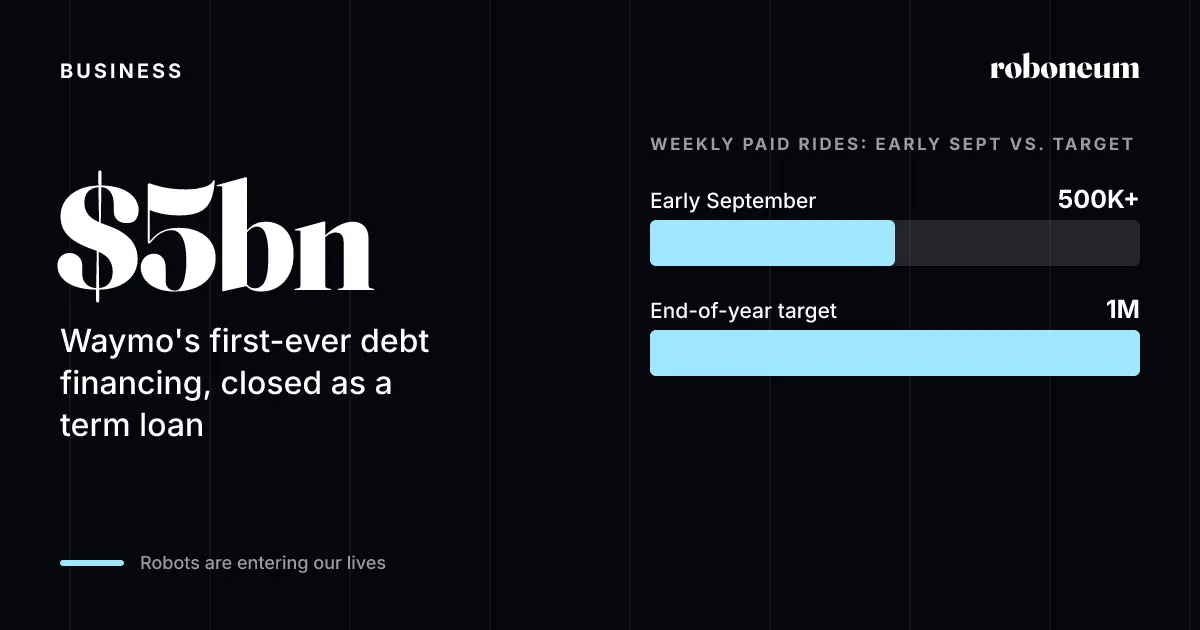
Waymo Closes Its First Debt Deal: a $5 Billion Term Loan
Waymo has closed a $5 billion term loan, the first debt financing in its history, led by PIMCO, Blackstone and Sixth Street. The company has not detailed how it will spend the money.
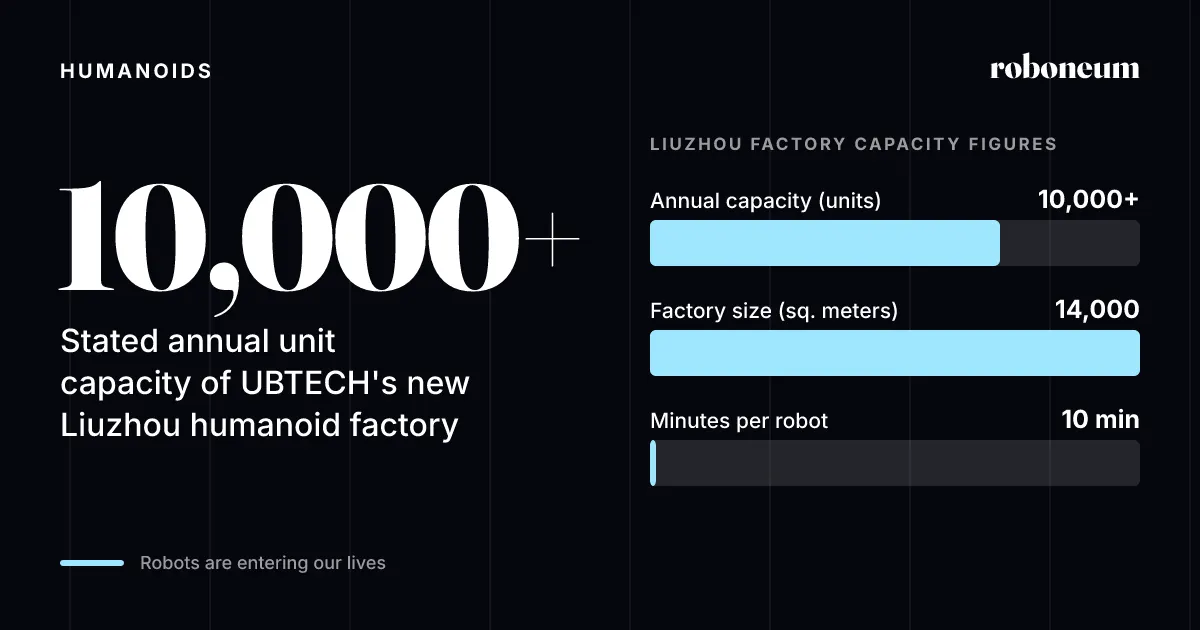
UBTECH and FAW-Volkswagen to Test Humanoid Robots in Logistics
UBTECH and FAW-Volkswagen signed a deal on Oct 8 to develop and test humanoid robots for factory logistics. It covers testing and demos, not a confirmed rollout.
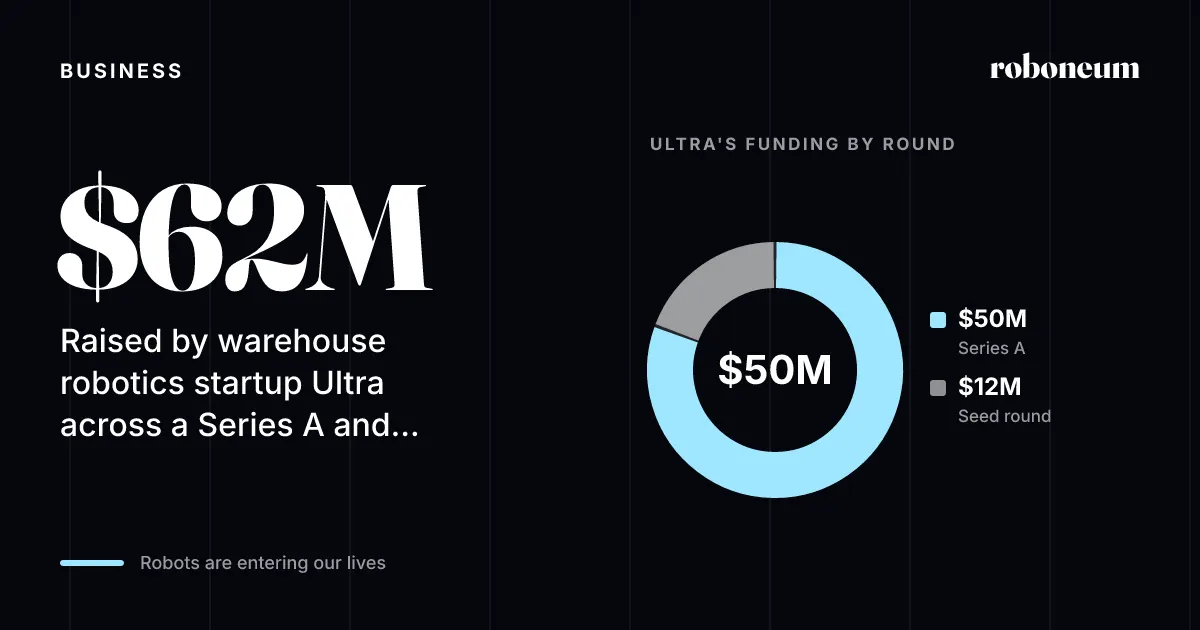
Ultra Raises $62 Million for Warehouse Robots as a Service
Brooklyn startup Ultra raised $62 million and expanded its partnership with Physical Intelligence. It leases warehouse robots by subscription, splitting robot bodies from AI brains.